Two weeks from brief to production launch
A national publisher's audience was being primed to use this platform on a specific date. Every scope decision had to be made against the calendar, not the wishlist.
When COVID-19 shut Main Street, USA TODAY needed a way to point a national audience at the local businesses still open. We designed and launched Support Local - a discovery platform with map search, business categorization, and gift-card purchase paths - from brief to live in two weeks. It was picked up by The Washington Post and a stack of national outlets the week it launched.


March 2020. Lockdowns rolling state-by-state. Restaurants, shops, gyms, salons - every Main Street business in the country was suddenly cut off from its foot traffic, and there was no national, neutral place a reader could go to find out which of them were still open, still selling gift cards, still hanging on. USA TODAY decided to be that place. The brief came to us on a compressed timeline most agencies would have refused: design, build, and launch a national local-business discovery platform in two weeks.
The platform had to be national in coverage but personal in feel - a reader in Cincinnati needed to find their corner cafe the same way a reader in Tucson found theirs. It had to support map-based discovery, category filtering, and a direct path for buyers to send money to a business via gift cards. And it had to hold up the day it launched, because USA TODAY's editorial coverage was already cued to point at it.
We scoped it to what could actually ship in fourteen days, picked the integrations that gave us national business coverage out of the box: Google Places for location intelligence, an editorial submission lane for businesses to add themselves, and a v2 list for everything outside the core loop. The platform went live on schedule. The Washington Post wrote it up. Other national outlets followed.
A national publisher's audience was being primed to use this platform on a specific date. Every scope decision had to be made against the calendar, not the wishlist.
USA TODAY did not have an in-house local business directory. We needed scalable location intelligence and credible business data for all 50 states ready the moment we shipped.
The platform's whole pitch was find businesses near you. Map performance, marker density, mobile gestures, and category filtering had to work on launch day at unknown scale.
Live location lookups, place details, and business categorization came from an external API with quota limits, latency variance, and rate-limit behavior that had to be cached and degraded gracefully.
The point was to send real money to real businesses, fast. The UX had to connect purchase intent to whatever gift-card surface a given business already had.
USA TODAY editorial was going to drive the launch. The Washington Post and other outlets picked it up the same week. There was no historical baseline to provision against.
Two weeks does not leave room for layered approvals, sprint ceremonies, or let's revisit that on Monday. We collapsed the engagement into one war-room channel, scope-froze on day one, and made every subsequent decision against a single question: does this make launch? Anything that did not went into a v2 list.
Single kickoff with USA TODAY. Locked the feature list: map discovery, category browse, business detail, gift-card path. Google Places was identified as the data backbone within the first hour.
Wireframed the four core surfaces: home, map search, business detail, gift-card hand-off. High-fidelity comps were produced while the build started on the shell.
Next.js application with server-rendered category and location pages, client-side map interactions, and category-based browse routes.
Wired Google Places for business lookups, place details, and categorization. Built a caching layer between the app and the API to absorb traffic spikes and keep quota use predictable.
Built the gift-card discovery and hand-off surface: the user-facing path that lets a reader send money to a featured business.
Final QA, mobile pass, accessibility check, and smoke test against quota. Coordinated launch with USA TODAY editorial and watched the traffic curve as national outlets picked it up.
The map is the front door. A reader opens the site, the map centers on their location, and nearby businesses show up as category-coded markers. From there it is two interactions to a business detail page and a path to send them money.
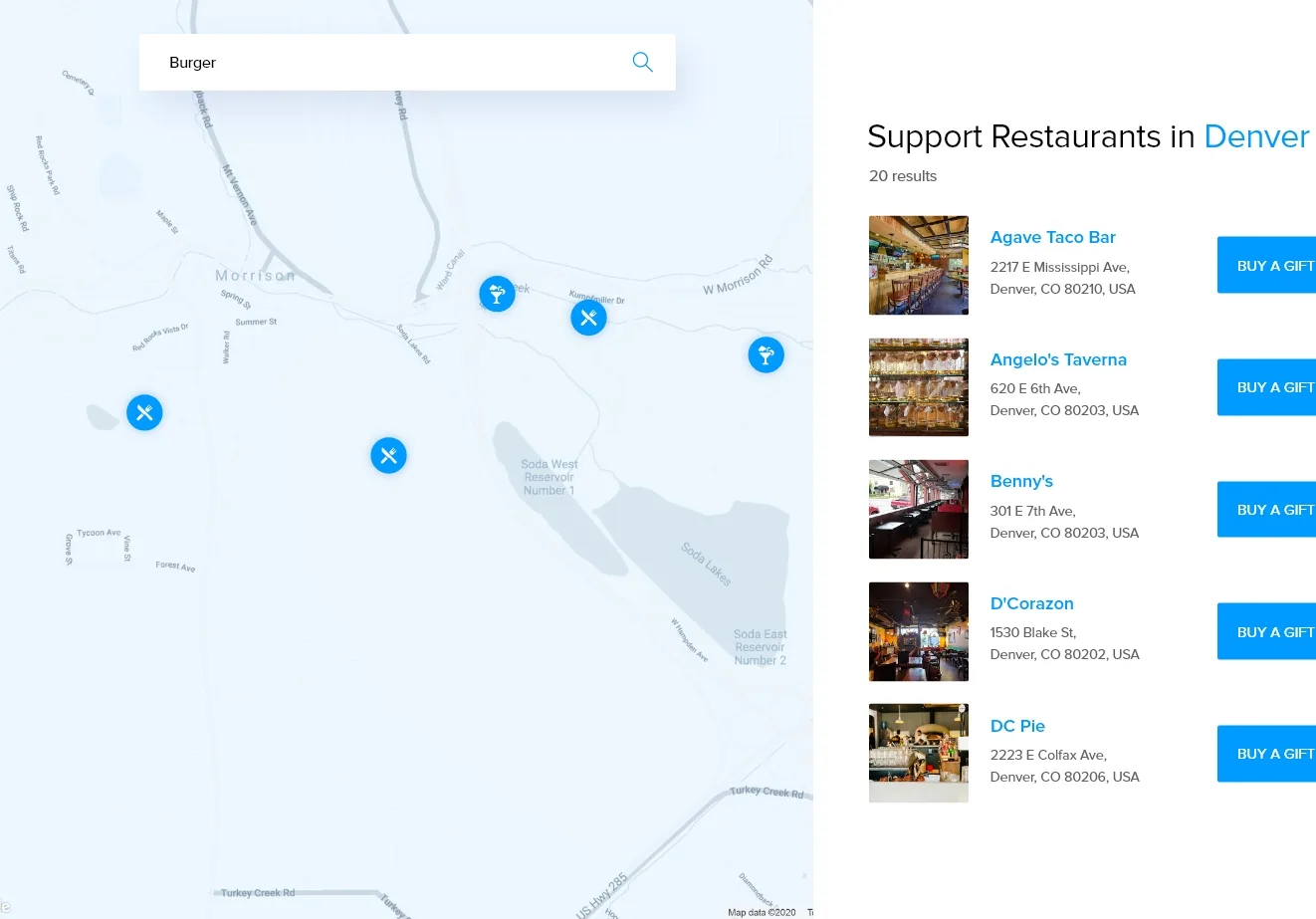 MAP - NATIONAL
Beyond the map, category-and-keyword search let readers land directly on restaurants, bookstores, salons, gyms, or any local business type in their ZIP. Google Places data sat behind a cache layer that flattened quota use during launch traffic.
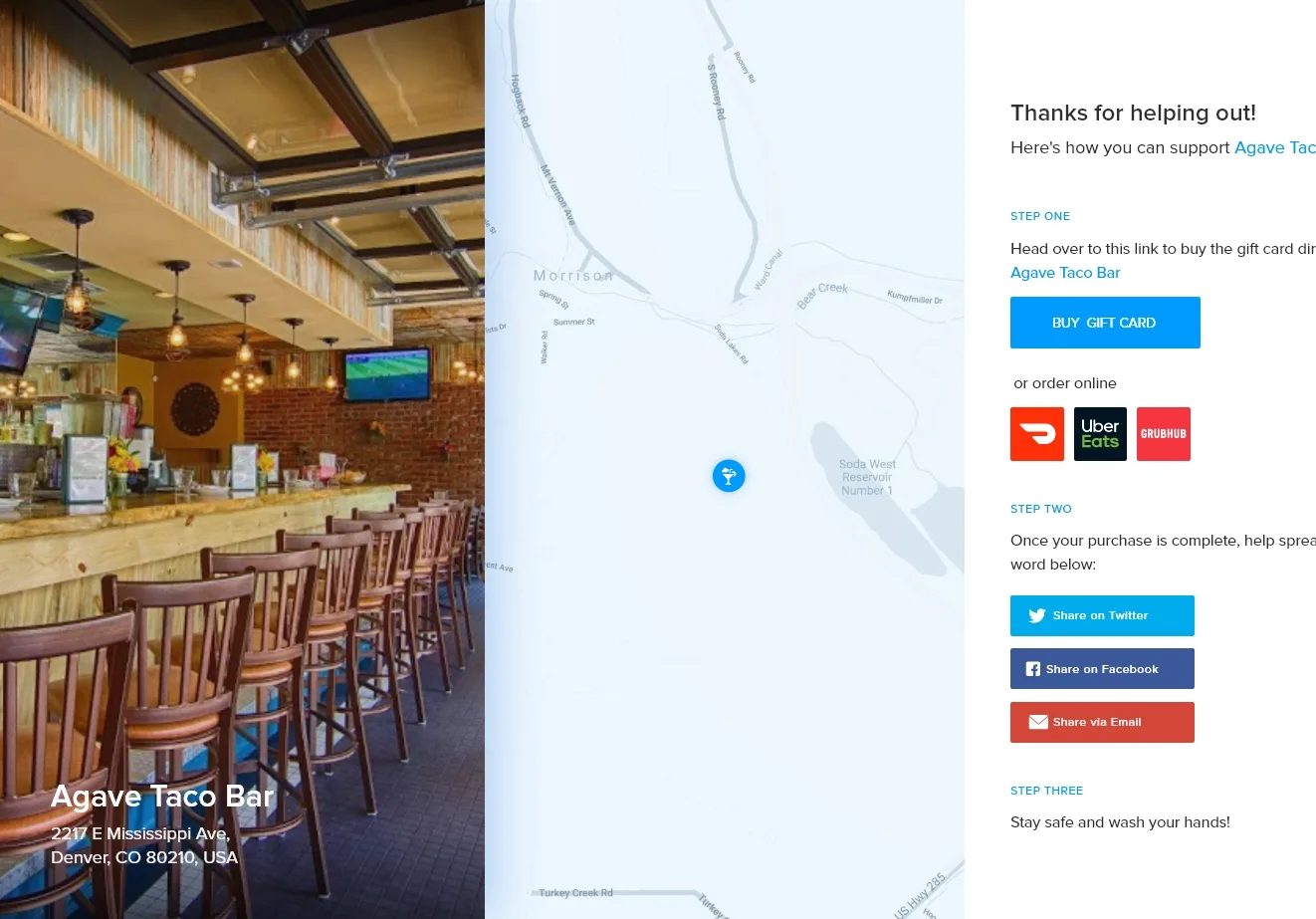 SEARCH - LIVE
Discovery without a way to act on it would have missed the point. Business detail surfaces promoted the clearest available path to buy a gift card or support the merchant while physical storefronts were closed.
 GIFT CARDS - LAUNCH
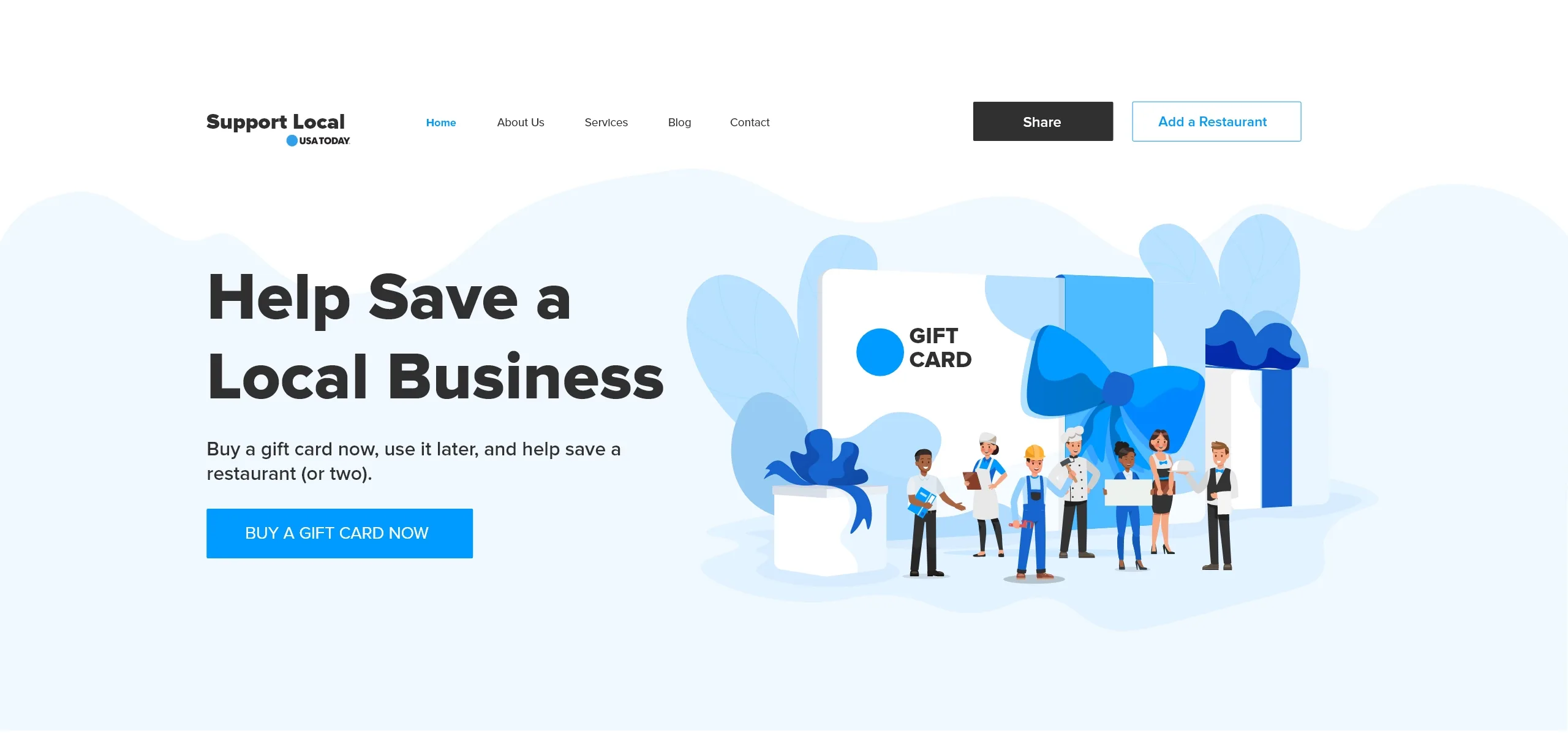 01 / Homepage - discover businesses near you
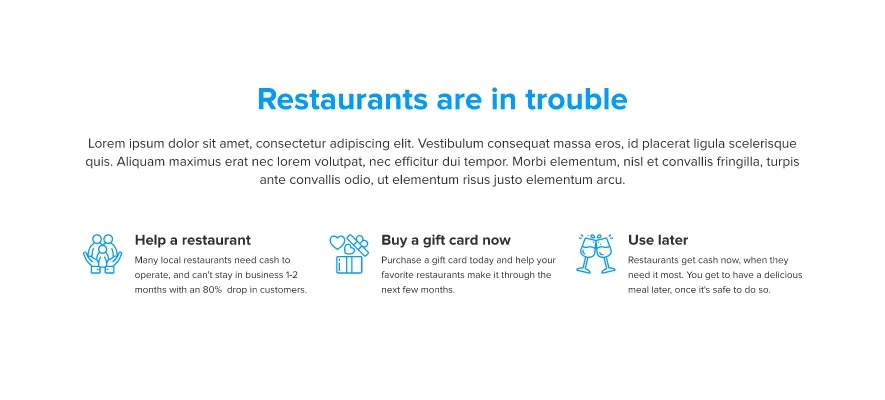 02 / Wide coverage
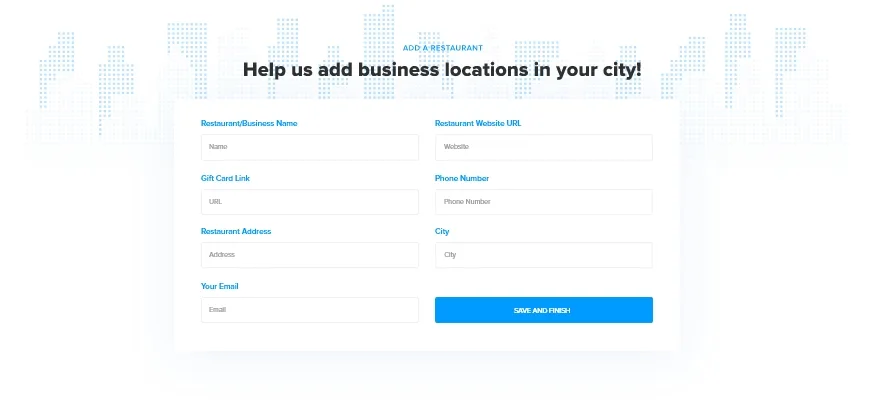 03 / Easy adding new listings
Fourteen days is not work harder - it is decide faster. The single most important act of the sprint was the day-one scope freeze: a short list of features that absolutely had to ship, and a longer list that consciously did not.
Readers landing on Support Local were stressed, in a hurry, often on a phone, and often on a slow connection. The interface had to be obvious in the first second: map, category, business, gift card.
The map gave readers spatial context they could not get from a list; the search gave them a path when they already knew what they were looking for. We carried this pattern into later discovery surfaces.
A tight sprint team at RTW working directly with USA TODAY product. One shared channel for the full two weeks. No ceremonies, no status decks - just the launch date.
Not every engagement is a 14-month replatform. Some are 14-day launches with a national audience already pointed at them. If you have a deadline that other teams told you was impossible - we'd like to hear about it.